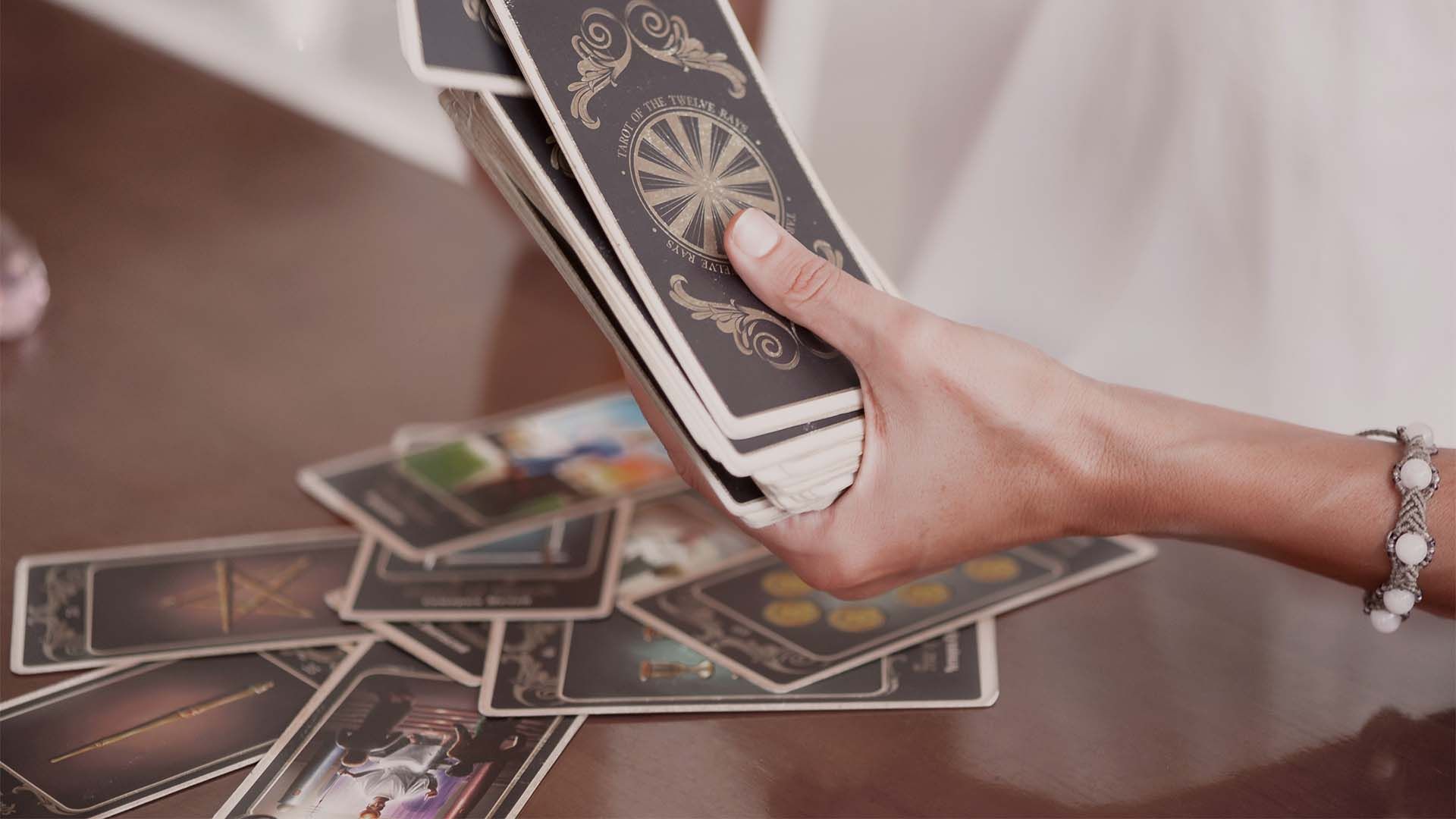
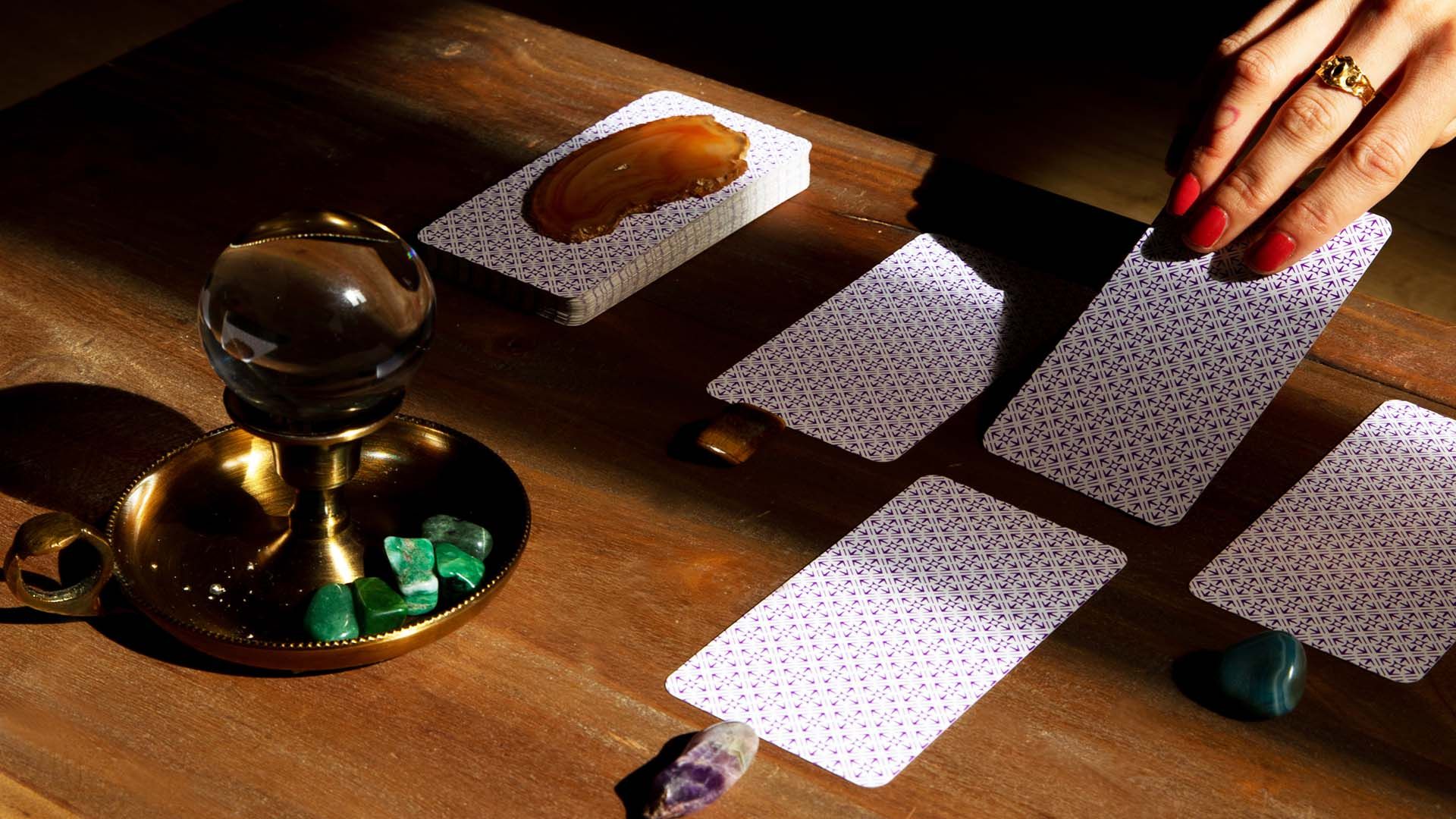
Sales of tarot decks have doubled recently, and newcomers to the world of tarot have questions. We’ve got answers, thanks to the tarot pros we consulted. Read on for expert advice on the importance of shuffling and pulling cards, plus techniques to make the process your own.
Understanding the meaning of tarot cards is essential for an effective and tuned-in tarot reading. But according to experts, the steps beforehand — namely, shuffling and pulling the cards — are equally important. Here’s why.
What Are Tarot Cards and What Are the Benefits?
Tarot cards originated in France and Italy in the early 15th century as simple playing cards. It was not until 17th-century Italy that the cards were used for divinatory purposes and evolved into the 78-card structure that all tarot decks mirror today.
Orla Bird, a tarot reader and creator from Zagreb, Croatia, says tarot cards are “filled with symbolic meaning” and that each of the cards in a deck “tells a different story,” which is why people use tarot cards to find clarity around all sorts of questions and concerns. You can have a general reading or focus on a single issue weighing on you, like an upcoming job interview or a relationship that has ended.
Angie Banicki, a tarot reader, writer, and mystic in Malibu, California, tells DailyOM, “The card pictures, numbers, and astrological ties are a way for us to communicate with our higher selves.”
As a tarot card reader myself, I too use tarot cards as a resource for self-growth and personal well-being (and not as tools for fortunetelling, the occult, or magic, though you will find tarot card experts who feel otherwise).
Interested in learning more? Check out The Art of Intuitive Tarot
How to Shuffle Tarot Cards
Immediately before the reading begins, as a way to “set up” a reading, you should shuffle your tarot card deck. Settle yourself in a position and environment, whether that’s alone in a room or cross-legged in the sand, that feels safe and comfortable to you. Then center yourself (I do this similarly to how I meditate) so that your mind is clear and focused, not wandering.
There is no “wrong” way to shuffle, Banicki says. “I tell people to shuffle the way it feels right,” she says. “The less you think about it, the better.”
Here are a few shuffling techniques suggested by the experts.
3 Tarot Card Shuffling Techniques
- The Pile Shuffle This one is easy. Simply put the cards face down on the floor and move them around with your hands until you feel they are fully mixed.
- The Overhand Shuffle
- This is the method that both Banicki and Bird prefer. Hold the deck on its side in your dominant hand. Using your nondominant hand, take cards from the back of the deck and shuffle them into the front. Do this until your intuition tells you to stop.
The Art of Intuitive Tarot
- The Riffle or “Casino” Shuffle
- Similar to shuffling regular playing cards, separate the deck into two sections. Place one in each hand. Using your thumb and index finger, bend the top of each section so each stack carefully folds into the other.
Banicki also notes that if a card happens to fly out while you’re shuffling, don’t dismiss it! She encourages readers to view this as a message.
Bird agrees. In fact, she considers a “flier card” to be one of the most important cards in the reading because it obviously wants to appear.
How to Pull Tarot Cards
Like shuffling, both experts say that there is no single best way to draw — or pull — tarot cards. The key is to figure out what works for you in this very personalized practice. Here are methods used by Banicki and Bird.
3 Tarot Card Pulling Techniques
- Fan Method “After I shuffle, I spread the cards out with my right hand and then use my left hand to pull out the cards,” says Banicki. “I place them face down in whatever spread I am choosing to access the message. Once they are [all placed] down and I'm feeling ready, I flip them over and read out the message.”
- Cut-and-Pull Method
- Bird says that once her cards are shuffled, she cuts the deck and pulls the cards from the top. “Sometimes, I even shuffle the cards again between each pull.”
- Flier Cards
- As mentioned earlier, our experts suggest acknowledging any cards that fly out as you shuffle, but in this method of pulling cards for a reading, you only use flier cards. Continuously shuffle as you ask each question, one by one, and wait for a card to “fly out” for each question.
Will a Tarot Reader Let You Touch Their Cards?
Some tarot card readers will allow you to touch their cards, while others prefer to be the only person handling their deck.
Banicki, for example, says, “I have this strange thing with the energy of the cards and not wanting anyone else to touch or put their energy on them.” During a tarot card reading for a client, she pulls the cards herself. “They are my connection to the divine and I want to be able to feel that connection only through me,” she says.
Bird, on the other hand, believes that allowing clients to handle the cards grants physical access to their subconscious. “I always let them cut the deck because that way, they get to cut it in the place they sense is right,” she says. “Their action directly affects which cards will be revealed to carry the message.”
Storing and Caring for Your Tarot Cards
Once you’re finished with a reading, simply slide the cards back in the deck, one by one, in different parts of the deck.
There’s a variety of different methods for storing your tarot cards too. I’ve dabbled in many myself. Try the way that speaks to you, such as:
- Leave a clear quartz crystal on them to cleanse and spiritually “recharge” the deck.
- Store them in a drawstring pouch of whatever material you prefer.
- Keep them safe in the box they came in.
- Wrap them in cloth and place them somewhere special.